Localized termite activity in South Florida requires precise structural intervention rather than arbitrary broad-spectrum pesticide application. Drywood termite spot treatment relies on detecting localized frass…
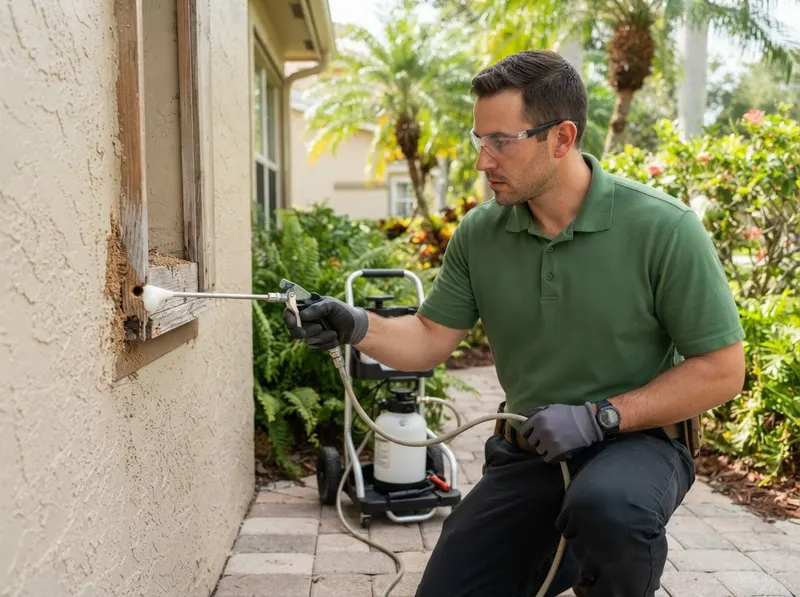
Localized termite activity in South Florida requires precise structural intervention rather than arbitrary broad-spectrum pesticide application. Drywood termite spot treatment relies on detecting localized frass ejections and gallery voids in structural framing, followed by the mechanical introduction of expanding foam insecticides. In accordance with the Florida Department of Agriculture and Consumer Services, structural pest control applicators must hold certified licensing under Chapter 482 of the Florida Statutes. Technicians inject formulations containing active ingredients such as fipronil or imidacloprid, regulated under EPA pesticide safety standards, directly into kick-out holes. As detailed in the University of Florida IFAS Extension guidelines, expanding foam expands at ratios up to 30:1, coating convoluted internal chambers where standard liquid residuals fail to migrate.
Spot treatment serves properties with isolated, accessible infestations, contrasting with whole-structure tenting involving sulfuryl fluoride gas. Properties in Davie communities such as Forest Ridge, Ivanhoe, and Long Lake Ranches frequently exhibit localized infestations along roof eaves, window trims, and exposed rafter tails. Research from the Entomological Society of America emphasizes that localized direct injection minimizes structural disruption, allowing occupants to remain inside the premises without vacating for multiple days. However, the procedural trade-off centers on spatial scope: spot foaming treats verified, accessible gallery voids, whereas concealed structural framing inside complex multi-layered architectural framing cannot always be reached without exploratory drywall access.
Environmental conditions across Broward County, specifically high relative humidity exceeding 75% near the Tree Tops Park and Flamingo Gardens corridors, accelerate wood moisture retention and drywood colony development. When evaluating timber stability in older single-family properties around Playland Isles or equestrian properties bordering the Robbins Preserve, applicators cross-reference structural load conditions using ASTM D143 wood testing methods and moisture mapping via NIST scientific measurement protocols. Termite galleries containing moisture levels above 15% provide optimal conditions for colony expansion into adjoining trim boards. For structures in Shenandoah and Riverstone, technicians coordinate treatment parameters aligned with Florida Building Code structural provisions to protect structural integrity during precision drill-and-treat protocols.
Operational deployment involves a standardized three-step sequence. First, the applicator maps all active kick-out holes and uses acoustic tapping or electronic detection tools to delineate gallery boundaries. Second, technicians drill 1/8-inch access ports directly into the void spaces at 8-to-12-inch intervals along the infested lumber. Third, an expanding foam generator dispenses termiticide under controlled pressure, ensuring 360-degree contact across internal timber channels, followed by the insertion of matching wood dowels to seal the access ports. Structural property owners can obtain a concrete assessment by calling (754) 205-1586.
Every job gets a firm, written price after a free on-site visit.
For standards, safe disposal, and service guidance on pest control services in Davie, FL, useful references include U.S. EPA, ENERGY STAR, U.S. Dept. of Energy, Consumer.gov, U.S. Census Bureau, and Google Maps. General consumer and small-business resources are available from USA.gov, Better Business Bureau, FTC Consumer Advice, U.S. Small Business Administration, and Ready.gov.
Tell us about your drywood termite spot treatment and foaming job in Davie and we'll send a clear, written quote, usually the same day.
 PestGuard Pro Services